Why “polished stainless” is not a complete specification
Two people can ask for “satin stainless” and have noticeably different appearances in mind. Mechanical finishing depends on the starting surface, abrasive sequence, pressure, direction, contact time and the final finishing operation. That is why finish terminology should be backed by a recognised finish code, roughness requirement or agreed sample where appearance is critical.
The BSSA notes that terms such as ground, polished, brushed and buffed can be ambiguous on their own. For fabricated work, a physical sample or clearly agreed visual reference can be more useful than relying on a vague word.
Common finish terms you will see
Brushed or dull polished
A directional finish with a visible grain. It is widely used where a clean, consistent appearance is wanted without a mirror-like reflection.
Satin polished
A finer non-reflective finish. Satin finishes are often chosen for visible stainless where a smoother, more refined appearance is required.
Bright or mirror polished
A much more reflective finish created through progressively finer polishing stages. It demands more preparation and makes surface consistency important.
Ground finish
A coarser directional surface produced by abrasive grinding. It may be an intermediate stage before further polishing or a deliberate final appearance where the specification allows it.
Why the finish should be decided before fabrication
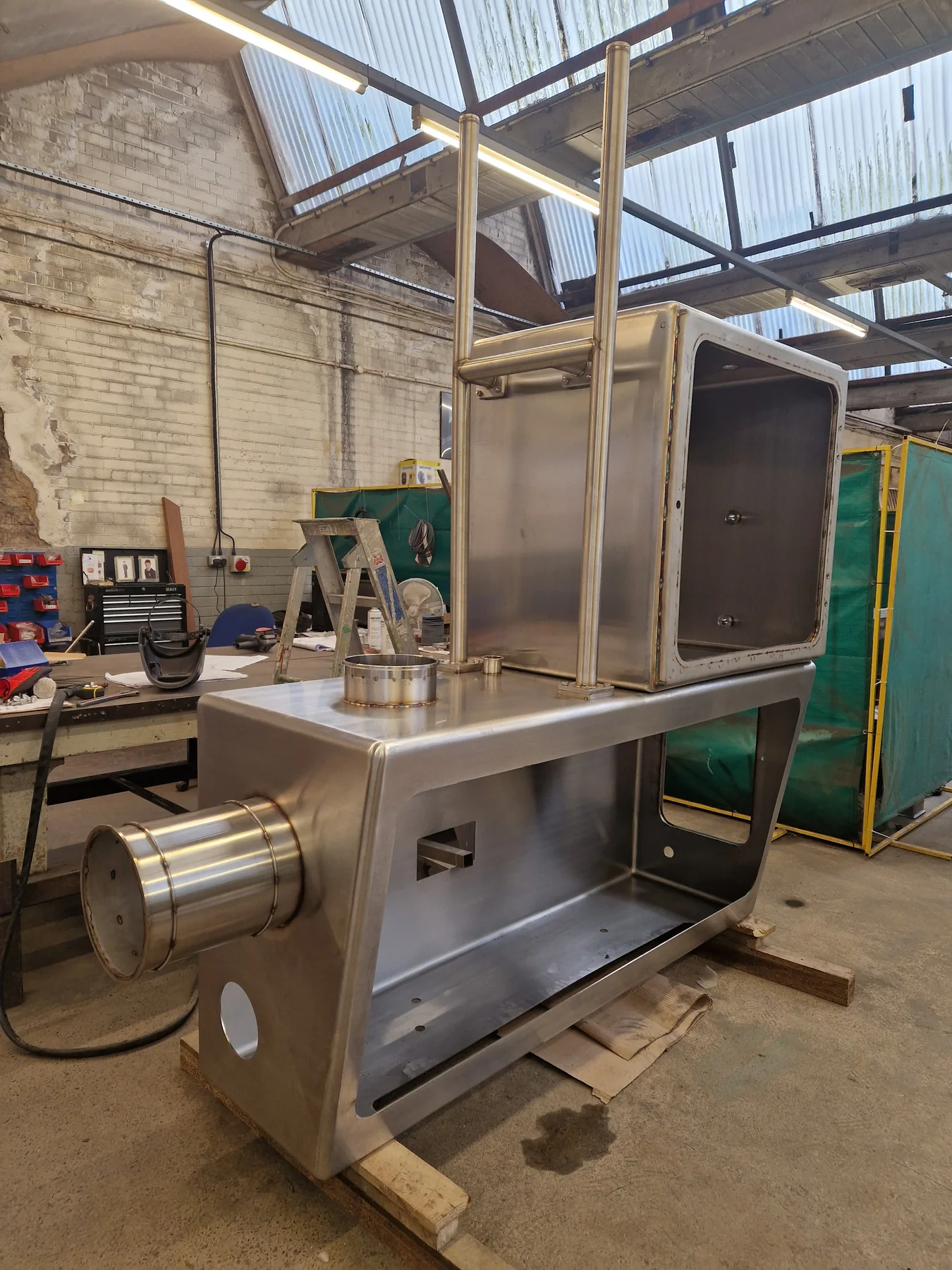
The required final appearance affects how a component is handled, welded, dressed and protected. If one face will be customer-facing and another hidden inside a machine, those faces should be identified. Grain direction may need to run consistently across adjacent panels. Weld placement and dressing can also influence the finished visual result.
Finish codes and roughness
BS EN 10088-2 includes finish designations for stainless flat products. BSSA guidance describes common special finishes including 1G/2G ground, 1J/2J brushed or dull polished, 1K/2K satin polished and 1P/2P bright polished. These are more precise than simply writing “nice satin finish” on a drawing.
Surface roughness may also matter for cleanability, appearance or process duty. Where a maximum Ra value is required, put it on the drawing and identify which faces it applies to. Zeus should not be expected to infer a hygienic or process-surface requirement merely from the word “polished”.
Welds change the finishing job
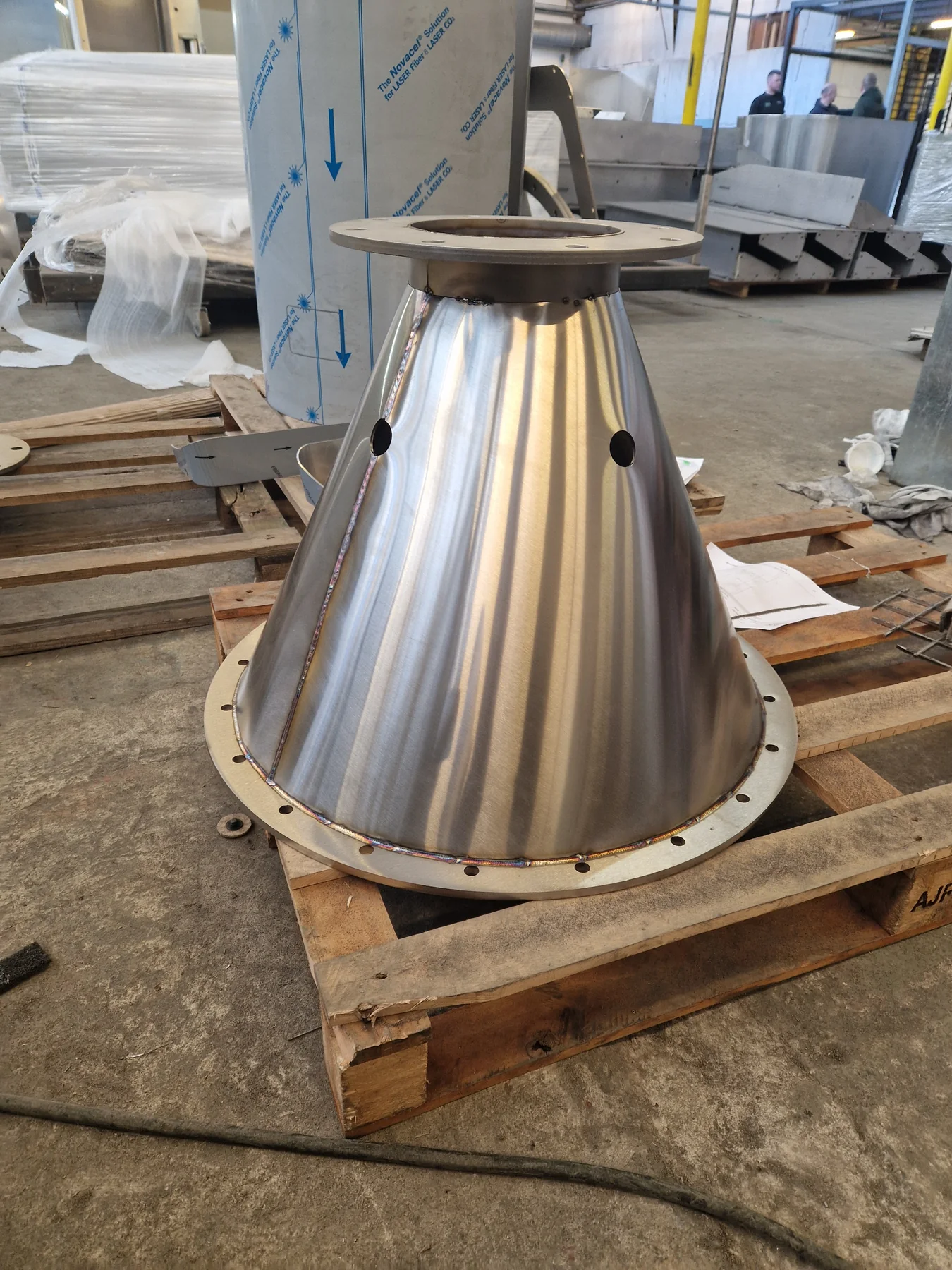
A sheet may arrive with a consistent mill or pre-polished finish, but TIG welding introduces a local heat-affected area and a weld profile. If the weld must disappear visually, be blended, or be left as a neat visible bead, that should be stated before manufacture.
Post-weld treatment can involve cleaning, dressing and refinishing. The correct route depends on what the component is for. A decorative visible panel is a different requirement from process equipment where corrosion resistance and cleanability are central.
Grain direction matters
Directional finishes should normally be treated as an orientation requirement, not merely a colour or shine. On folded panels, doors, covers and multi-part assemblies, inconsistent grain direction can be obvious once the parts are installed side by side.
- Mark grain direction on drawings for visible parts.
- Identify matching panels or adjoining faces.
- Say whether welds are to be dressed flush or left visible.
- Protect finished surfaces through handling and delivery.
Can scratched polished stainless be repaired?
Often, but the ease of repair depends on the finish. Directional brushed finishes can sometimes be locally reworked more readily than highly reflective finishes. Mirror-like finishes are harder to repair invisibly because local polishing can leave a different reflection or texture.
Finish and corrosion resistance are connected
Surface condition is not purely cosmetic. BSSA guidance notes that rougher or contaminated stainless surfaces can perform less well in service, and carbon-steel contamination can cause rust staining. Good handling and finishing practice therefore protects both appearance and stainless performance.
What to put on a stainless fabrication drawing
- Grade: for example the specified 304/304L or 316/316L designation
- Base material thickness
- Required finish code or plain-language finish backed by a sample
- Visible faces
- Grain direction
- Any Ra requirement
- Whether welds remain visible, are dressed or blended
- Critical cosmetic areas where marks are unacceptable
Sources and further technical reading
Technical finish terminology was checked against the British Stainless Steel Association guidance on mechanically finished stainless steel and its summary of finishes to BS EN 10088-2.
Frequently asked questions
What is the difference between brushed and satin stainless steel?
Both are directional non-mirror finishes, but satin is generally a finer, smoother finish. Exact appearance varies, so an agreed finish code, roughness or sample is safer than relying on the name alone.
Can Zeus polish stainless after TIG welding?
Stainless TIG welding and finishing can be considered as one fabrication requirement. State whether welds are to remain visible, be dressed, blended or polished and identify the required final appearance.
How do I ask a fabricator to match an existing stainless finish?
Provide a reference sample if possible or clear close-up photographs in good light. Mark the visible faces and grain direction on the drawing so the matching requirement is unambiguous.
Have a fabrication to price?
If this guide relates to a live job, send the drawing, material, thickness, quantity, finish, delivery postcode and required date. Zeus can then review the actual manufacturing requirement.
Send us your drawing